Unveiling The Network-level Resource Curse for Resilience-based Spatial Energy Planning
Abstract
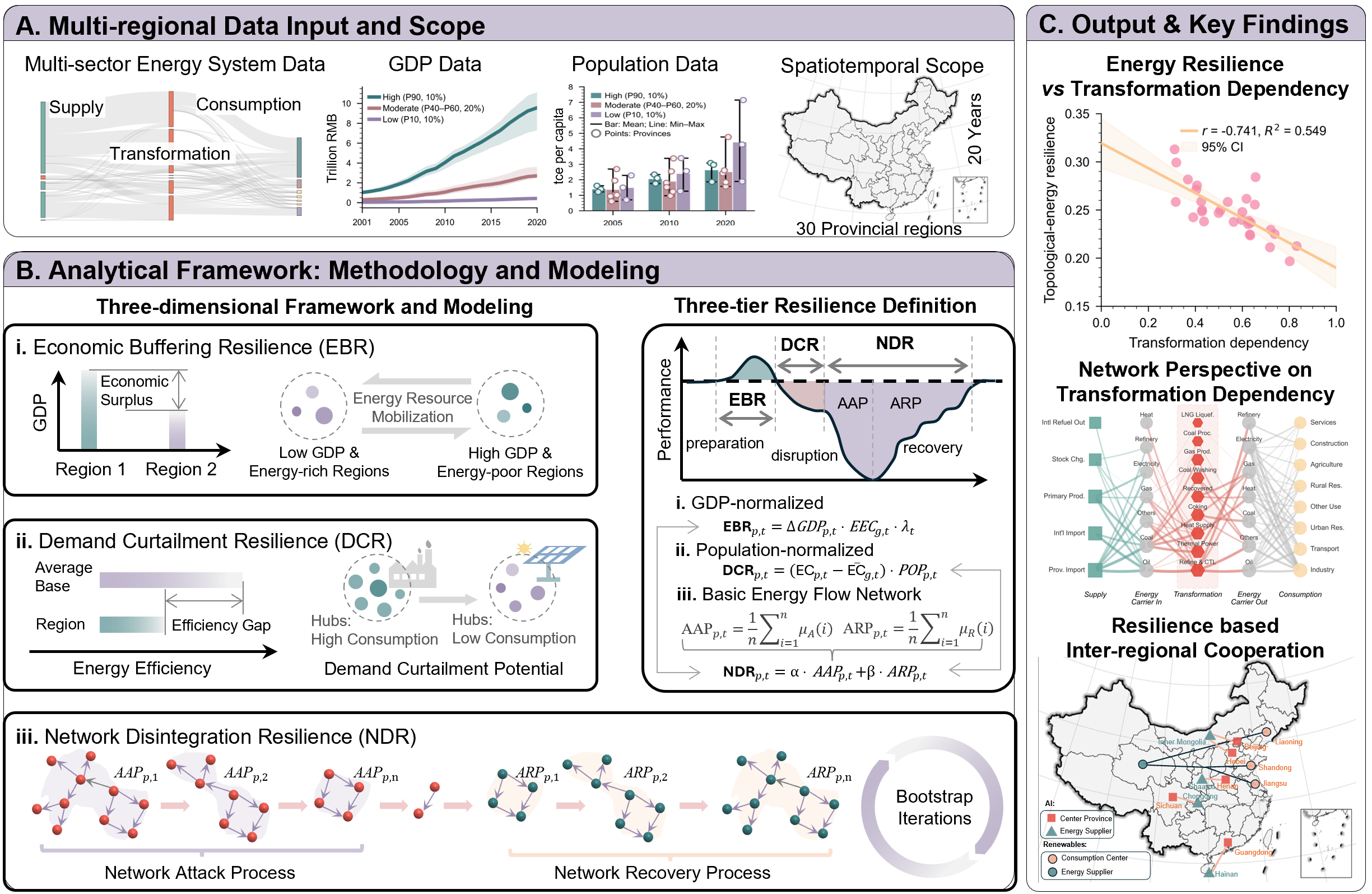
The global energy system is undergoing a structural transformation driven by the dual pressures of AI-driven demand growth and escalating climate extremes, but existing assessment frameworks often overlook the topological fragilities inherent in subnational energy networks. Here, we analyze 20 years of subnational energy data from China by using graph theory to construct 600 directed energy flow networks with a novel three-dimensional framework. We introduce a transformation dependency index to quantify intermediate processing risks and a full-trajectory network disintegration design for cross-system resilience benchmarking. Our analysis reveals a systemic mismatch between economic capacity and structural resilience across different regions. Coastal economic hubs, while economically robust, are structurally fragile, whereas interior energy-exporting provinces exhibit high structural resilience despite limited resources. Transformation dependency emerges as the dominant driver of this inversion. We identify a network-level resource curse in which macro-policies such as the "West-to-East Power Transmission" project entrench regional export specialization, disproportionately concentrating systemic vulnerability in provinces central to national energy security. Exploiting the non-overlapping vulnerability profiles across the three resilience dimensions, the framework independently validates 50% of nationally planned AI data center locations in the "Eastern Data, Western Compute" strategy, and identifies one previously unrecognized candidate hub and three new strategic energy corridors. Our framework relies on widely available statistical inputs, rendering it scalable and transferable across major economies that maintain subnational energy statistics at comparable resolution.
Research Framework